
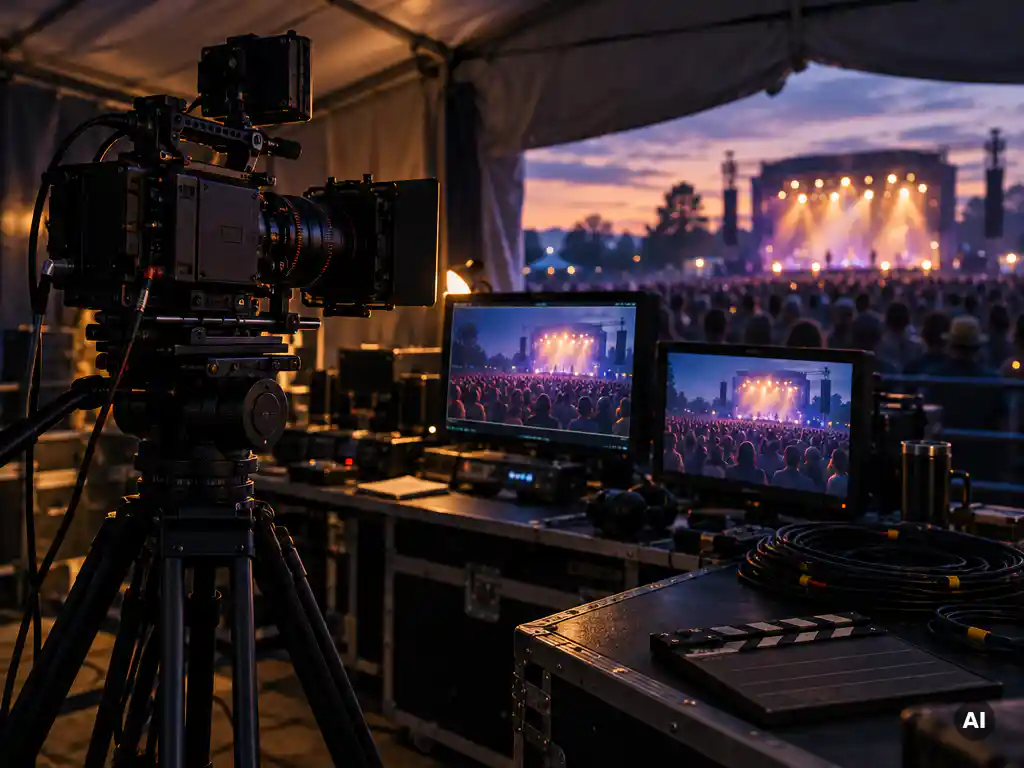
What happens during pre-production for a festival shoot?
Pre-production defines the production framework before anyone arrives on site. It covers the creative and technical brief, site surveys, camera and infrastructure planning, crew selection, budgeting, and delivery requirements. Decisions made here determine what the festival can capture, broadcast, and distribute.
The first step is understanding what the content is for. A festival that needs live screens (IMAG) at the stages has different requirements from one that wants a livestream, a broadcast channel, or vertical-native clips for social platforms. Most festivals need several of these at once, and the planning must reflect that.
A typical pre-production phase includes:
- Defining deliverables: live screens, livestream, broadcaster feeds, recap films, social content
- Surveying the site for camera positions, cable routes, power, and connectivity
- Selecting crew and equipment suited to the project rather than defaulting to a fixed supplier
- Agreeing on a production schedule with the festival’s stage management and artist liaison teams
- Planning backup connectivity and redundancy for anything going live
Independence matters at this stage. When the production partner is not tied to a specific equipment house or fixed creative team, the technology and people can be chosen purely based on what the festival needs.
How are cameras and crews planned across multiple stages?
Cameras and crews are planned stage by stage, based on each stage’s audience size, artist profile, lighting, and output needs. A main stage might carry a full multicamera setup with a dedicated director, while a smaller stage runs a leaner configuration, often controlled from a central or remote gallery.
The key variables are camera count, camera type, and operator placement. Large-sensor cameras give a cinematic look with shallow depth of field and strong low-light performance, which suits festival stages with heavy lighting changes. Specialist positions such as cranes, robotic heads, and wireless handhelds add variety to the coverage.
Crew planning follows the same logic. Directors, camera operators, replay and graphics operators, sound engineers, and shaders are scheduled around the festival’s running order, with changeover times and rest breaks built in. Multi-day festivals need rotating teams so quality stays consistent from the first act to the last.
Many productions now direct several stages from a single remote gallery in a central media village. This reduces the on-site footprint at each stage and makes it easier to share resources, but it requires solid network infrastructure between the stages and the gallery.
How does live broadcasting and streaming work on site?
Live broadcasting on site works by routing camera signals to a production gallery, mixing them into a program feed, and sending that feed through encoders to streaming platforms, television partners, or on-site screens. Reliability depends on the infrastructure between the stage and the audience, so redundancy is built in at every critical point.
The signal path generally follows these steps:
- Cameras capture the performance and send signals to the production gallery over fiber or other transport.
- The director cuts between cameras while audio is mixed and synchronized with the picture.
- Graphics, replays, and branding are added to the program feed.
- The finished feed is sent to encoders for livestream platforms, to broadcast partners, and to on-site screens.
- A monitoring team watches the outgoing signal and switches to backup paths if a fault appears.
Connectivity is the most common risk. A well-designed setup uses redundant uplinks and backup encoding so a single failure does not take the stream offline. Distribution can run over IP, satellite, or HTTP streaming, depending on the partners receiving the feed.
Large events show how far this can scale. Our Tomorrowland work spans live screens, global distribution, and coordination of several editions across countries.
How are artist consent and rights clearance handled?
Artist clearance is handled through contracts negotiated with each artist’s management, label, or record company before the festival. These agreements define whether a performance may be filmed, streamed live, broadcast, or kept for later use. Without a signed clearance, footage of that set cannot be distributed.
Clearance is more detailed than a simple yes or no. Agreements typically specify:
- Whether the set can be livestreamed, broadcast, or recorded only
- Which platforms and territories may carry the content
- How long the footage may be used and in what formats
- Whether the artist approves any edited versions or clips
Timing is the biggest practical challenge. Some artists confirm late or change terms close to the event, so clearance runs alongside production rather than finishing before it. A clearance manager works with the multicamera team on site so that camera and broadcast decisions always reflect the latest status of each set.
Specialist platforms can streamline contracting and on-site follow-up, keeping a clear record of what each artist has agreed to. That record protects both the festival and the artists once content is published.
How are recordings managed, archived and delivered during the festival?
Recordings are managed through a structured media workflow: footage is ingested to high-speed storage, labeled by stage and artist, backed up, and made available for delivery during the festival. Good media management means editors, social teams, and broadcast partners can find and use the right material within hours, not days.
A reliable workflow usually includes:
- Recording every camera and the program feed so nothing depends on a single copy
- Consistent naming and metadata so clips are traceable to a stage, set, and artist
- Redundant storage with at least one verified backup
- Delivery routes to broadcasters, platforms, and press partners
- Long-term archiving once the festival ends
Rights status feeds into this process as well. Only footage with the correct clearance should move to distribution, so media managers need to know which sets are approved and for which uses.
Speed also matters for social content. Vertical-native clips, filmed with mobile-first platforms in mind, can be cut and published while the festival is still running, extending its reach beyond the grounds.
How long does festival post-production and editing take?
Festival post-production typically takes anywhere from a few days for quick highlight edits to several weeks for polished aftermovies or full set releases. The timeline depends on the number of deliverables, the amount of footage, and how much color grading, sound work, and approval rounds each one requires.
Several factors drive the schedule:
- Volume of footage: multi-stage, multi-day events generate large amounts of material to review and organize.
- Type of deliverable: a same-day social clip is far faster than a cinematic recap or full live set.
- Grading and audio: footage shot in log formats needs color grading, and live audio often needs cleanup and mixing.
- Approvals: artist, management, and festival sign-off can add days, especially for full sets.
A well-prepared media workflow shortens editing considerably. When footage is labeled, backed up, and cleared during the event, editors spend their time shaping the story rather than searching for files. Real-time editing infrastructure on site can also produce first cuts while the festival is still running.
How CK Productions helps with festival video production
CK Productions is an independent technical video production and broadcasting partner for music festivals and live events. We act as an extension of your production team, managing the technical complexity so you can focus on the live experience.
Here is how we support festival video production:
- Multicamera and large-sensor cinematic production, including multi-stage coordination
- Livestreaming and broadcast distribution, with redundant connectivity where required
- Live screen production (IMAG) across stages
- Media management, archiving, and delivery to broadcasters and platforms
- Coordination of artist rights clearance together with specialist partners
- Vertical-native content for mobile-first platforms
- Independent selection of crews, equipment, and suppliers for each project
Planning a festival or live event and want a production setup built around your goals? Contact CK Productions to discuss your project and get a tailored plan.
Frequently Asked Questions
How early should I start planning video production for my festival?
Ideally, start planning 6 to 9 months before the event for large multi-stage festivals, and at least 3 to 4 months for smaller ones. This gives you time to complete site surveys, lock in connectivity and infrastructure, book the right crew and equipment, and begin artist clearance conversations. Starting with a clear brief on deliverables (IMAG, livestream, broadcaster feeds, social content) makes every later decision easier.
What should I do if a headline artist refuses to be filmed or streamed?
Confirm exactly what the artist has declined, since some will refuse a livestream but allow IMAG screens or recording for later use. Build flexibility into your plan with a fallback, such as switching the stream to another stage, running a pre-recorded segment, or showing a branded holding graphic during that set. Keeping a clearance manager in contact with the camera and broadcast teams ensures nothing is accidentally sent out without permission.
How can I keep my livestream online if the internet connection fails?
Design for redundancy from the start with at least two independent uplinks, for example a fiber line plus a bonded cellular or satellite backup. Pair these with backup encoders so one failed device doesn’t take the stream down. Test the failover before doors open, and make sure a monitoring operator is watching the outgoing signal and can switch paths immediately.
How do I decide how many cameras each stage needs?
Base the camera count on the stage’s audience size, the artist’s profile, and what the footage will be used for. A main stage with live screens and a broadcast feed may need a full multicamera setup with specialist positions like cranes or robotic heads, while a smaller stage can run with three or four cameras controlled from a central gallery. Walk through the site and running order with your production partner to match coverage to priorities rather than spreading equipment evenly.
What are the most common mistakes in festival media management?
The most frequent mistakes are relying on a single copy of footage, inconsistent file naming, and not tracking which sets are cleared for distribution. Avoid these by recording every camera plus the program feed, applying a naming convention that includes stage, artist, and set, and keeping at least one verified backup. Share the current rights status with your media managers so only approved material reaches partners and social channels.
How can I publish social content during the festival without delaying the main production?
Set up a dedicated social team with its own access to the media workflow, so they can pull cleared clips without interrupting the broadcast or IMAG crew. Plan vertical-native filming for specific moments, such as crowd reactions, backstage, and key performances, rather than cropping widescreen footage afterward. Agree on approval steps in advance so clips can be published within hours.
How can I speed up post-production for an aftermovie?
Share your creative references and deliverable specs with the editors before the festival so they can plan the story and shots needed. Make sure footage is labeled, backed up, and cleared during the event, and consider first cuts on site while the festival is still running. Limiting approval rounds and naming a single decision-maker on the festival side can also save days.
Related Articles
- What is the difference between aftermovies and promo videos?
- Why do festival organizers invest in video content every year?
- How many cameras are needed to film a music festival?
- When should you start planning video coverage for your festival?
- How do you film a festival in 2026 without disrupting guests?