
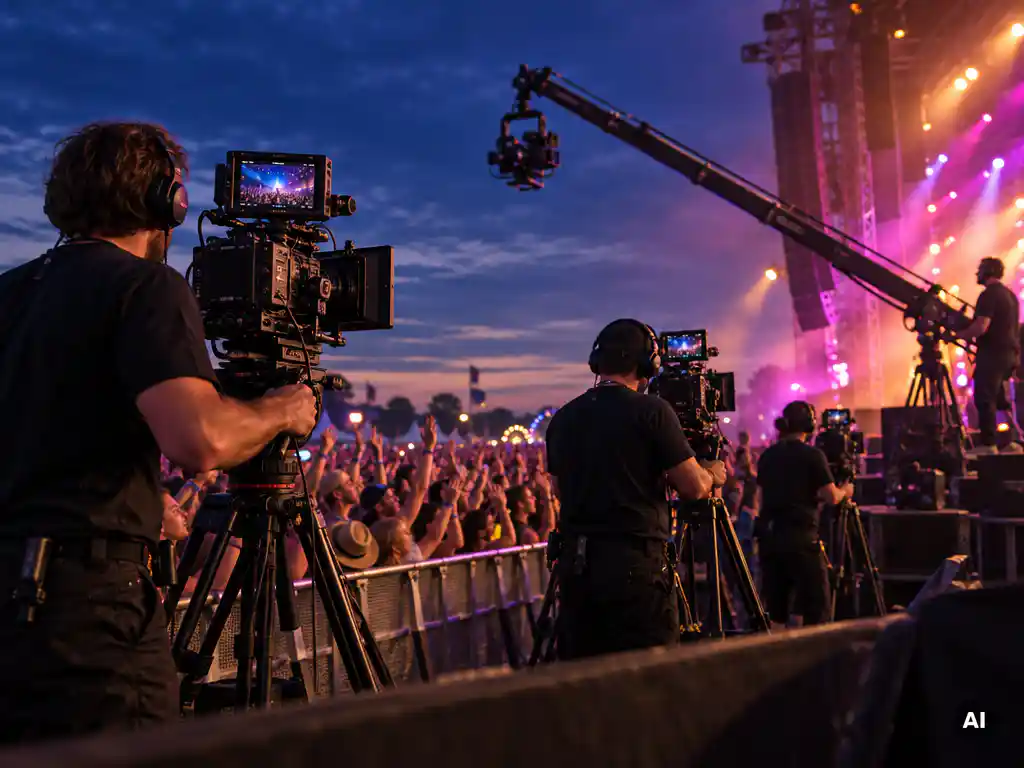
Most music festival productions use between 4 and 8 cameras per stage for a quality multicamera result, while a simple livestream or recap can run on 2 to 3. Large festival coverage across several stages often adds up to dozens of cameras in total.
The right number depends on stage size, deliverables, and the story you want to tell. Below, we answer the most common related questions about festival video production camera planning.
What factors change the number of cameras needed?
The number of cameras needed for a music festival depends mainly on stage size, audience scale, the number of stages, and the type of deliverable. A small club stage may work with two or three cameras, while a main stage with a large crowd usually needs six or more.
Beyond those basics, several other factors shape the final count:
- Stage layout: Wide stages, long runways, and deep stage designs need more angles to cover artists properly.
- Crowd coverage: Showing audience energy requires dedicated cameras, often on a crane, jib, or platform.
- Venue and safety constraints: Camera positions are limited by sightlines, rigging, and crowd safety rules.
- Visual ambition: A cinematic look with large-sensor cameras often calls for specialized positions and lenses.
- Lighting and production design: Complex lighting shows can reward extra angles that capture the full atmosphere.
Every festival is different, so camera count should always follow the goals of the production rather than a fixed formula.
What is a typical camera setup for one stage?
A typical main stage setup uses 6 to 8 cameras: a wide front-of-house shot, two or three handheld or roaming cameras, a stage-level camera pit position, a crowd camera, and often a jib or crane for sweeping movement. Smaller stages may run on 3 to 4.
Each camera has a clear job in the mix:
- Wide shot: A locked or lightly operated camera from the front-of-house position that frames the whole stage.
- Tight shot on the artist: A long-lens camera that captures faces, instruments, and expressions.
- Pit or stage-side camera: A handheld or Steadicam operator who delivers close, dynamic angles.
- Crowd camera: A dedicated position that captures reactions and atmosphere.
- Movement camera: A jib, crane, or rail system that adds scale and motion.
- Specialty camera: Options include a robotic head, a hanging camera, or a remote POV.
For example, in our cinematic production for Charlotte de Witte’s fifteenth anniversary show at Flanders Expo, we used Sony large-sensor cameras in HDR S-Log3 and a ceiling-suspended SHOTOVER G1 stabilized head. This kept the floor clear for the audience while still delivering fluid, precise framing.
Do livestreams need more cameras than aftermovies?
Not necessarily. Livestreams need enough cameras to switch between angles in real time without gaps, typically 4 to 8 for a main stage. Aftermovies can use fewer cameras on stage, but they often rely on additional roaming cameras that capture the crowd, backstage areas, and festival atmosphere.
The difference lies in how the footage is used rather than how much of it there is.
Livestreams and live broadcasts
Live production is directed in real time, so the director needs dependable angles at every moment. If one camera drops out, others must cover. That is why redundancy and a well-balanced mix of wide, tight, and crowd shots matter more than sheer numbers. Multi-stage festivals also need a separate camera package and directing setup per stage.
Aftermovies and recaps
Aftermovies are edited later, so you can capture material over several days with a smaller team and a flexible approach. The focus shifts to variety: drone shots, backstage moments, festival grounds, fans, and artists. A few specialized cameras, often with a cinematic look, can matter more than a large stage-based camera count.
How many operators and crew are required per camera?
Most manned cameras need one camera operator each. Beyond operators, a production usually adds a director, a vision mixer, camera shaders or engineers, and technical support, so total crew per stage is often larger than the camera count alone suggests.
The exact crew depends on the setup, but a typical live stage team can include:
- One operator per manned camera
- A director who calls the shots
- A vision mixer or technical director who switches the program
- A camera shader or vision engineer who keeps exposure and color consistent
- Technical support for signal flow, cabling, and intercom
- Camera assistants or runners for larger or more complex positions
Robotic or fixed cameras reduce the operator count but still need monitoring and control. Remote galleries can also centralize directing for several stages in one location, which changes how the crew is distributed across the site.
How does camera count affect production budget?
Each additional camera adds cost through equipment, operators, cabling, signal infrastructure, and shading or engineering support. The impact is rarely linear, because supporting infrastructure such as switching, intercom, and transmission is shared across the production.
The main budget drivers connected to camera count include:
- Camera type: Large-sensor cinema cameras and specialty rigs cost more than standard broadcast cameras.
- Lenses and support gear: Long lenses, jibs, and stabilized heads raise the total.
- Crew size: More cameras mean more operators, assistants, and shading support.
- Infrastructure: More feeds require more cabling, routing, and storage capacity.
- Post-production: More camera angles increase the editing and media management workload.
A smart camera plan puts budget where it adds the most visible value, such as a strong main stage package, rather than spreading cameras thinly across every position.
How do you decide the right camera plan?
Start from the end result and work backward. Define what you want to deliver, who will watch it, and where it will be shown, then match camera positions, types, and crew to those goals within your budget and venue limits.
A practical approach follows these steps:
- Clarify deliverables: livestream, broadcast feed, big screen IMAG, aftermovie, social content, or a combination.
- Review the site: stage design, sightlines, rigging options, power, and connectivity.
- Prioritize your key stages and sets, since not every stage needs the same coverage.
- Plan for reliability with backup positions and, where needed, redundant signal paths.
- Consider vertical and social formats early, since they may require dedicated cameras rather than crops of a wide shot.
- Review the plan with an experienced technical production partner before locking the budget.
Experience with comparable events is valuable here. Large international festivals such as Tomorrowland show how multi-stage coverage, live broadcasts, and media distribution can be planned as one connected workflow.
How CK Productions helps with festival camera planning
CK Productions is an independent technical production partner, so we design the camera plan around your event rather than around fixed equipment or crews. We select the right people and technology for each stage, format, and budget.
Here is how we support your festival video production:
- Camera and crew planning matched to each stage and deliverable
- Multicamera and cinematic large-sensor production for livestreams and recaps
- Multi-stage coordination, live screen feeds, and broadcast delivery
- Media management, archiving, and distribution to partners
- Reliable workflows with backup systems where required
Planning a festival or live event and unsure how many cameras you need? Contact CK Productions and we will help you build a camera plan that fits your goals and budget.
Frequently Asked Questions
How early should I start planning my festival camera setup?
Ideally start three to six months before the event, especially for multi-stage festivals or productions with specialty rigs. Early planning gives you time to review the site, secure rigging and camera positions, confirm artist filming permissions, and book the right operators and equipment. Last-minute plans often force compromises on camera positions and crew quality.
What should I do if an artist or management restricts filming?
Raise this during the planning phase and ask for the filming rules in writing, including which songs, camera positions, or deliverables are allowed. If restrictions apply, adapt your plan: use wider shots from fixed positions, limit pit access, or focus on crowd and atmosphere content. Having a flexible plan with alternative angles makes it easier to adjust without losing the story.
How can I add backup and redundancy without doubling my camera count?
Focus redundancy on the most critical elements instead of duplicating everything. Use a flexible roaming camera that can cover for a failed position, keep spare camera bodies and lenses on site, and build redundant signal paths such as backup cabling and a secondary recording. Recording isolated feeds on each camera also protects your footage if the live signal drops.
Can I use drones at a music festival?
Often yes, but flying over crowds is heavily restricted in most countries. You will typically need a certified pilot, local permits, and a defined flight zone away from the audience, and weather conditions can still cancel flights. Drones work best for establishing shots of the festival grounds and are usually captured when the area is empty or in a controlled zone, so plan them as a bonus rather than a core stage camera.
Do I need separate cameras for social media and vertical content?
If social content is a priority, yes. Cropping a wide 16:9 shot to vertical often loses the artist or the action, so a dedicated vertical camera or a roaming operator framing specifically for 9:16 gives much better results. Even one dedicated social camera can add a lot of value without needing a full extra crew.
What are the most common mistakes when planning festival cameras?
The most common mistakes are spreading cameras too thinly across all stages, ignoring sightlines and rigging limits until the last minute, and skipping a dedicated crowd or movement camera. Another frequent error is underestimating supporting needs like cabling, intercom, shading, and media storage. Prioritize your key stages first, then scale coverage on the others.
How do I get started if this is my first festival video production?
Begin by listing your deliverables, such as a livestream, big screen feed, or aftermovie, along with your budget and the number of stages. Share the site plan and stage designs with an experienced technical production partner, who can propose a camera plan with positions, crew, and infrastructure. Ask for options at different budget levels so you can see where each extra camera adds real value.
Related Articles
- What is the difference between aftermovies and promo videos?
- Can festival footage help you sell more tickets next year?
- What should festival organizers know before hiring a video crew?
- How does festival video production work from planning to edit?
- When should you start planning video coverage for your festival?