
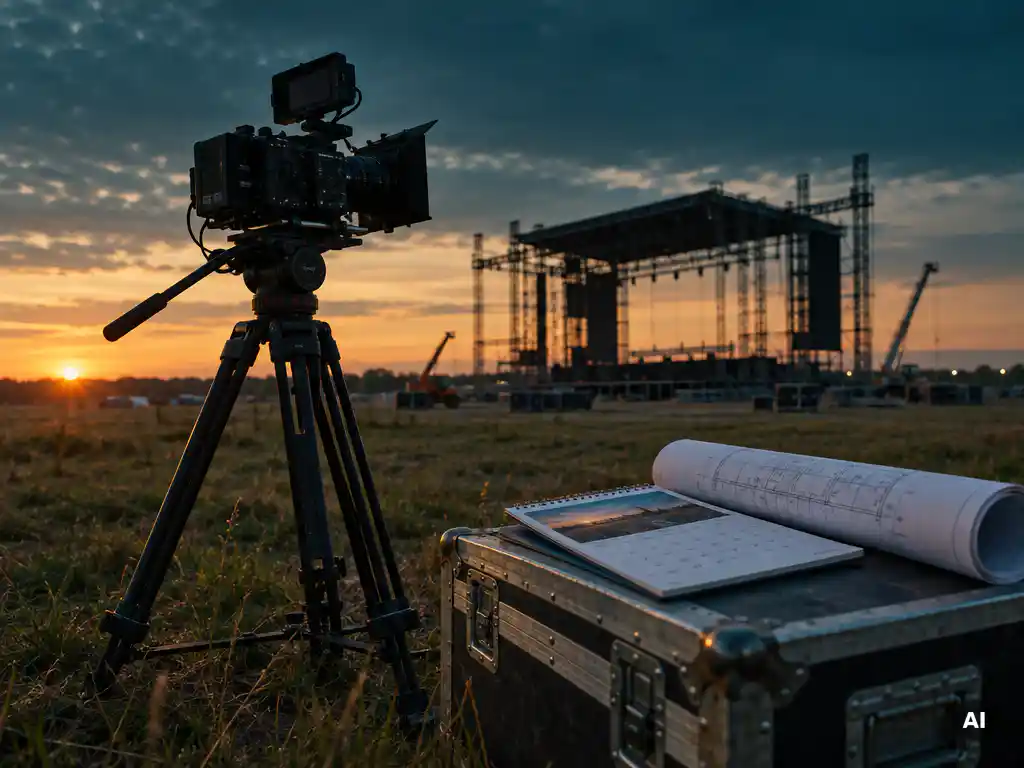
Start planning video coverage for your festival 9 to 12 months before the event. That window gives you time to book the right crew, lock technical and stage decisions, secure artist clearances, and finalize your livestream and distribution plans without compromising quality or budget.
Smaller festivals can work with a shorter runway, while multi-stage or broadcast-heavy events need every month of it. Below, we answer the most common questions about festival video production timing, from the first scoping call to show day.
What does a festival video planning timeline look like?
A realistic festival video planning timeline runs from 9 to 12 months before the event to the final show day. It moves from scoping and budget, through crew booking and technical design, to rights clearance, distribution setup, and rehearsals in the final weeks.
Here is a typical sequence for a multi-stage festival:
- 9 to 12 months out: Define goals, budget, and the scale of coverage (IMAG screens, livestream, aftermovie, social content).
- 6 to 9 months out: Book key crew, confirm the production approach, and start discussing infrastructure with the venue.
- 4 to 6 months out: Lock camera positions, stage plans, and connectivity requirements. Open artist clearance conversations.
- 2 to 4 months out: Finalize distribution partners, streaming platforms, and delivery formats.
- 2 to 4 weeks out: Run technical tests, confirm workflows, and brief the full crew.
Treat these as guidelines. A single-stage concert needs far less lead time than a festival with simultaneous broadcasts across several stages.
Why book your video crew months in advance?
You should book your video crew months in advance because experienced directors, camera operators, and technical specialists are in highest demand during festival season. Early booking secures the people you actually want, rather than whoever is still available, and gives your team time to prepare properly.
Festival season compresses many productions into a few summer months, and the best specialists get booked quickly. Late hiring often means compromising on experience, which shows up on screen and in live reliability.
Early booking also brings practical benefits:
- Your director can attend site visits and shape the camera plan around the real stage design.
- Crew can coordinate shifts, travel, and accommodation without last-minute costs.
- Equipment choices stay flexible, because gear is selected for the production rather than dictated by what is left.
For international productions, add extra time for travel arrangements, permits, and local crew sourcing.
When should technical and stage decisions be locked?
Technical and stage decisions should be locked 3 to 5 months before the festival. By then, camera positions, stage layouts, power and fiber routes, and screen placements should be fixed, because every later change ripples through crew planning, equipment lists, and budget.
Video has to fit around the stage, not the other way around. A late change to a stage roof, truss layout, or lighting rig can block sightlines or remove a planned camera position entirely. Sharing stage drawings with your video team as early as possible lets them flag conflicts while they are still cheap to solve.
The decisions worth locking early include:
- Camera positions, including any suspended or remote heads
- Control room or media village location
- Fiber, power, and network paths between stages
- Look and format, such as cinematic large-sensor capture versus a classic broadcast setup
- Live screen (IMAG) layout and content requirements
Cinematic productions in particular depend on early lighting conversations. Large-sensor cameras capturing in HDR respond very differently to extreme stage lighting than standard broadcast cameras, so the lighting designer and video director should align well before show day. Our work on Tomorrowland’s multi-stage live productions shows how much complexity grows when several stages and countries are involved.
How early should artist rights clearance start?
Artist rights clearance should start at least 3 to 4 months before the festival, and earlier for headliners or international acts. Clearing recording, livestream, and redistribution rights takes negotiation with management, labels, and publishers, and unresolved clearances can force you to blur, skip, or cut performances.
Clearance is not a single yes or no. Artists may approve a livestream but not on-demand replays, or allow aftermovie footage but not full sets. Each permission affects what you can publish and where.
To keep clearance manageable:
- Decide early which formats you plan to publish: live, on-demand, highlights, social clips.
- Include recording and broadcast terms in artist contracts from the start, not as an afterthought.
- Track approvals per artist and per format in one shared overview.
- Plan fallback content for acts that decline coverage.
Specialized clearance platforms and partner companies can handle contracting and on-site follow-up, which takes pressure off festival teams.
When should livestream and distribution plans be finalized?
Livestream and distribution plans should be finalized 2 to 4 months before the festival. That gives you time to confirm platforms, test connectivity, agree on delivery specs with broadcasters and media partners, and build redundancy into the signal path before show day.
Distribution is more than pressing “go live.” Each destination, whether a streaming platform, TV partner, or social channel, has its own format, latency, and delivery requirements. Vertical-native content for mobile-first platforms needs to be planned and framed differently from a widescreen broadcast feed, ideally with dedicated capture rather than cropped footage.
Key items to confirm in this phase:
- Streaming platform and player requirements
- Broadcast and media partner delivery formats and schedules
- Internet connectivity, including backup lines for the main uplink
- Archiving and file delivery after the event
- Social content workflow and approval chain
Reliable live delivery depends on testing. Build in at least one full technical run before the festival, so problems surface in rehearsal rather than in front of your online audience.
What happens if festival video planning starts too late?
If festival video planning starts too late, you typically face limited crew availability, rushed technical compromises, unresolved artist clearances, and higher costs. The result is often thinner coverage, fewer camera angles, and a higher risk of technical issues during live broadcast.
Late planning rarely makes a festival impossible to film, but it narrows your options. Common consequences include:
- Weaker crew and gear choices: The best people and equipment are already committed elsewhere.
- Blocked camera positions: Stage and rigging decisions were made without video input.
- Missing content: Acts without clearance cannot be streamed or published.
- Untested workflows: Connectivity and broadcast chains go live without proper rehearsal.
- Budget pressure: Rush fees, last-minute travel, and emergency equipment sourcing add up quickly.
If you are already inside the ideal window, prioritize. Secure your director and technical lead first, lock your must-have camera positions, and start artist clearance immediately. A smaller, well-executed production beats an ambitious one that falls apart on the day.
How CK Productions helps with festival video planning
At CK Productions, we act as an independent technical production partner, so you get the right crew and technology for your festival rather than whatever fits a fixed inventory. We join early and work as an extension of your internal team.
- Planning broadcast workflows, multicamera setups, and multi-stage coverage
- Selecting crew and equipment tailored to your production
- Coordinating livestreaming, live screens, and delivery to media partners
- Managing media workflows, archiving, and content distribution
- Supporting artist clearance together with specialized partners
Planning a festival and want to get your video coverage right from the start? Contact us today for a first scoping conversation about your timeline.
Frequently Asked Questions
How do I get started if I've never planned video coverage for a festival before?
Start by defining what you actually need: IMAG screens, a livestream, an aftermovie, social content, or a combination. Write down your rough budget, number of stages, and expected audience reach, then book a scoping call with an experienced production partner. Bringing stage drawings, your festival dates, and a list of distribution goals to that first conversation will speed up planning considerably.
How much of my festival budget should I set aside for video production?
There is no fixed percentage, because costs depend on the number of stages, camera count, livestream requirements, and whether you need broadcast-level delivery. A practical approach is to prioritize in tiers: first IMAG and core coverage, then livestream, then extras like aftermovie and vertical social content. Ask your production partner for a tiered quote so you can scale scope up or down without redoing the whole plan.
What if a headliner refuses to be filmed or streamed?
Plan for this from the start by preparing fallback content, such as crowd shots, backstage moments, interviews, or highlights from other acts. Check whether the artist would approve a limited option, for example a livestream of a few songs, highlights only, or no on-demand replay. Keeping a shared overview of approvals per artist and per format helps you adjust your live schedule quickly.
How can I reduce the risk of technical failure during a livestream?
Build redundancy into the signal path, including backup internet lines for your main uplink and spare equipment for critical points. Run at least one full technical test in the weeks before the festival, using the same connectivity and workflows you will use on show day. Assign a dedicated technical lead who monitors the stream and can switch to backups without waiting for approvals.
Can I produce vertical social content from the same cameras as my main broadcast?
You can, but the results are usually weaker because cropping a widescreen feed loses framing and impact. For better results, plan dedicated vertical-native capture with its own operator, camera, or mobile rig. Decide this during your technical planning phase so the positions, crew, and approval workflow are already in place.
What is the most common mistake festivals make with video planning?
The most common mistake is finalizing stage design, rigging, and lighting without involving the video team. This often blocks planned camera positions or creates lighting conditions that cameras handle poorly, especially for cinematic HDR capture. Share stage plans with your video director as early as possible so conflicts can be solved while changes are still cheap.
What should I do if I'm already less than six months from my festival?
Prioritize ruthlessly: secure your director and technical lead first, lock your must-have camera positions, and begin artist clearances immediately. Scale your ambitions to what can be delivered reliably, such as fewer cameras or a single livestream feed, rather than risking an overextended setup. A smaller, well-rehearsed production will always outperform an ambitious one that falls apart on the day.
Related Articles
- What is the difference between aftermovies and promo videos?
- What should festival organizers know before hiring a video crew?
- What is festival video production and what does it include?
- Why do festival organizers invest in video content every year?
- How does festival video production work from planning to edit?