
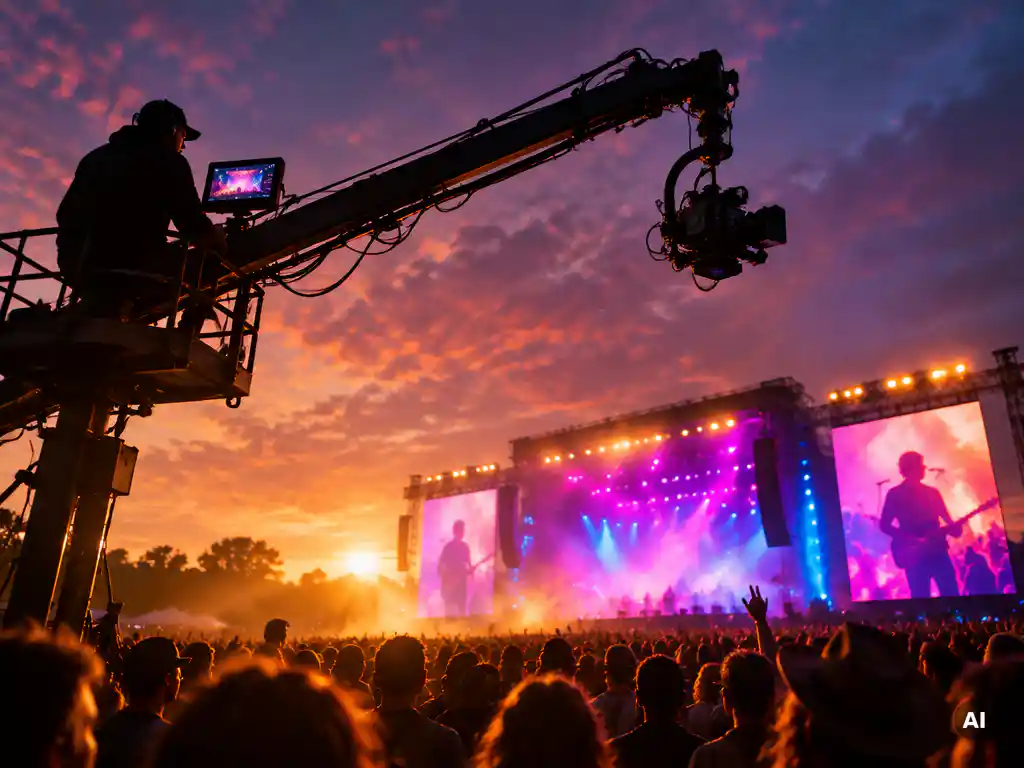
Festival video production is the technical planning, filming, live direction, streaming, and delivery of audiovisual content from a music festival. It typically includes multicamera coverage, live screen feeds, livestreams, aftermovies, social content, and media management. The scope ranges from a single stage recording to full multi-stage broadcasts with rights clearance and distribution to media partners.
What a festival actually needs depends on its size, number of stages, and goals for audience reach in 2026. The sections below answer the most common questions about crews, equipment, deliverables, livestreaming, rights, cost, and when to bring in outside help.
How does a multicamera festival crew actually work?
A multicamera festival crew works as one coordinated unit: camera operators capture different angles, a director selects shots live from a control room, and technical staff keep signals, audio, and recordings running. The result is a single, polished program feed assembled in real time.
On a typical stage, camera operators cover wide shots, close-ups, and roaming perspectives, while specialized positions such as ceiling-suspended stabilized heads or jibs add movement without blocking the audience. Every camera feeds into a gallery, which can sit in a truck or, increasingly, in a remote location on site. A director calls the shots, a vision mixer cuts between them, and a shader adjusts exposure and color so images match across cameras.
Behind the scenes, technical production managers handle signal flow, intercom communication, and recording. Many productions also run real-time editing, so highlights can be published while the set is still happening. Clear communication and rehearsed workflows matter more than any single piece of gear.
What equipment and crew do festivals typically need?
Most festivals need cameras, a control room or gallery, audio and signal infrastructure, reliable connectivity, and a crew to operate it all. The exact mix scales with the number of stages, whether the content is live or recorded, and how many outputs the festival wants to deliver.
A practical checklist for a multi-stage festival usually includes:
- Broadcast or cinema cameras, including large-sensor models for a more cinematic look
- Lenses, tripods, handheld rigs, and specialty camera supports
- A production gallery with switching, graphics, replay, and monitoring
- Audio feeds from the front-of-house or broadcast mix
- Fiber, cabling, and redundant network connections
- Storage and media management for recordings and fast turnaround
- LED screen or IMAG feeds for audiences on site
On the people side, expect directors, camera operators, shaders, engineers, graphics operators, audio specialists, and a production manager. Larger festivals often add drones, remote cameras, and dedicated editors for social content.
Which deliverables can festival video production include?
Festival video production can deliver live screen content, livestreams, full live sets, daily recaps, aftermovies, social clips, and archived footage. Each deliverable serves a different audience, from fans on site to viewers at home to sponsors and media partners looking for reusable content.
Common deliverables include:
- IMAG and screen content for audiences watching on site
- Livestreams or broadcast feeds distributed to platforms and media partners
- Full live sets published after the event
- Daily recaps edited during the festival
- Aftermovies that capture the full atmosphere
- Social and vertical-native clips for mobile-first platforms
Planning these outputs early shapes camera positions, recording formats, and editing capacity. A festival that wants vertical clips, for example, benefits from framing cameras and workflows with that format in mind rather than cropping widescreen footage afterward.
How does livestreaming a festival differ from recording it?
Livestreaming delivers content to viewers in real time with no chance to fix mistakes, while recording captures footage that can be edited and corrected later. That difference makes livestreaming far more demanding on connectivity, redundancy, and live direction.
When recording, the priority is image quality and complete coverage. Errors can be solved in post-production. A livestream, by contrast, needs stable upload bandwidth, backup encoders, and failover paths so a single point of failure does not take the broadcast offline. The director also has to make final decisions on the spot, and graphics, audio levels, and rights restrictions must all be correct before the signal leaves the site.
Many festivals do both at once: a live program feed goes out while isolated camera recordings are saved for later editing. Distribution adds another layer, since feeds may go to a festival channel, a streaming platform, or broadcast partners, each with its own technical requirements. A well-known example is a festival channel launched through an operator’s streaming platform, with stages directed from an on-site media village.
What is rights clearance and media management in festival video?
Rights clearance is the process of securing permission from artists, managers, labels, and rights holders before their performances are filmed, streamed, or published. Media management is the organized handling of footage from capture through storage, delivery, and archiving.
Without clearance, a festival cannot legally broadcast or republish a set, and a single missing agreement can force a performance to be blocked or removed. Clearance typically involves contracts that define what can be filmed, where it can be shown, and for how long. Starting these conversations well before the festival, and following up on site, keeps administration under control.
Media management covers naming conventions, high-speed storage, backups, and delivery to editors and partners. Good workflows mean a highlight clip can reach social media within hours, and the full archive stays organized for future use. Specialized platforms exist to track contracts and publishing rights, which helps teams stay accurate across dozens of artists.
How much does festival video production cost?
Festival video production costs vary widely because no two festivals need the same scope. The main drivers are the number of stages, camera count, live versus recorded delivery, crew size, connectivity requirements, post-production volume, and whether rights clearance is included.
A single-stage recording with a small crew sits at one end of the spectrum, while a multi-stage livestream with redundant infrastructure and daily edited content sits at the other. Useful budgeting questions include:
- How many stages need coverage, and for how many days?
- Is the output live, recorded, or both?
- Which deliverables matter most: screens, stream, aftermovie, or social clips?
- How much redundancy does the broadcast require?
- Who handles artist clearance and distribution?
The most reliable way to get an accurate figure is to share goals and constraints with a production partner and request a scoped proposal. Defining priorities first prevents paying for coverage that does not serve the festival’s objectives.
When should festivals hire an external production partner?
Festivals should hire an external production partner when internal teams lack the capacity, specialist skills, or broadcast infrastructure to deliver the planned coverage reliably. This is common for multi-stage events, livestreams, and productions with partner or broadcaster obligations.
Typical signs it is time to look outside include growing stage counts, new streaming ambitions, limited in-house technical staff, or a need for cinematic quality without buying equipment. An external partner can scale crews up and down by project, which avoids carrying a permanent team for a few busy days each year.
Independence also matters. A partner who is not tied to one equipment supplier or fixed creative team can select the most suitable crew and technology for each festival. Large productions such as Tomorrowland show how much coordination complex events require, yet smaller festivals and one-day concerts benefit from the same planning discipline.
How CK Productions helps with festival video production
CK Productions is an independent Belgian technical production partner based in Antwerp, with more than a decade of experience in live broadcasting and multicamera production for festivals such as Tomorrowland, Pukkelpop, Les Ardentes, and Rampage. We select the right crew and technology for every project and act as an extension of your team.
Here is how we support festivals:
- Multicamera and cinematic large-sensor production across one or many stages
- Livestreaming and broadcast delivery with resilient, redundant workflows
- Live screen production (IMAG) for audiences on site
- Media management, post-production, and distribution to partners and platforms
- Coordination of artist rights clearance together with specialized partner platforms
- Vertical-native content for mobile-first audiences
Planning a festival, concert, or technically complex live event? Contact CK Productions to discuss your goals and receive a production plan tailored to your stages, audience, and budget.
Frequently Asked Questions
How far in advance should I start planning festival video production?
Ideally begin 6-9 months before the festival for multi-stage or livestreamed events, and at least 3-4 months for smaller productions. Early planning gives you time to scope deliverables, secure connectivity and infrastructure, book crews, and start artist rights clearance, which is often the slowest part. Start by defining your goals and a rough stage and deliverable list, then request a scoped proposal from a production partner.
What should I do if a livestream drops during the festival?
A well-designed livestream has redundancy built in so a drop is handled automatically or within seconds: backup encoders, multiple internet paths (for example fiber plus bonded cellular), and a failover stream. If you don’t have these, the first step is to switch to the backup path, keep isolated camera recordings running so no footage is lost, and post a short holding slate or message for viewers. Afterward, review logs to find the failure point and fix it before the next day.
What if an artist refuses to be filmed or streamed?
It happens regularly, so plan for it in advance. Track clearance status per artist in a central list shared with the director and stream operators, and prepare a fallback such as a no-stream slate, a replay of another approved set, or alternate programming. Some artists agree to partial rights, such as the first few songs or on-site screens only, so negotiate those options early and confirm them in writing.
How do I decide how many cameras each stage needs?
Base it on stage size, the importance of the stage in your lineup, and your deliverables. A smaller stage recorded for archive might work with 3-4 cameras, while a main stage with IMAG screens and a livestream often uses 8 or more, including specialty positions like jibs or stabilized heads. Ask what each camera position adds in coverage and prioritize wide, close-up, and roaming shots before adding extras.
How can I get social clips online quickly during the festival?
Set up a dedicated editing and media management workflow before the event: fast shared storage, clear file naming, and editors who receive isolated camera feeds or live recordings in real time. Decide in advance which moments to prioritize, such as headliner highlights or crowd reactions, and use approved templates for graphics and captions. Framing some cameras for vertical output from the start saves time compared with cropping widescreen footage later.
What are common mistakes festivals make with video production?
The most common mistakes are deciding on deliverables too late, underestimating connectivity needs, skipping redundancy for livestreams, and leaving rights clearance to the last minute. Another frequent issue is poor media management, which makes it hard to find and deliver footage later. Avoid these by setting priorities early, running a technical rehearsal, and assigning clear responsibility for clearance and delivery.
How do I get started if my festival has never done video production before?
Begin with a clear goal: do you want to engage on-site audiences with screens, reach viewers at home with a stream, or create promotional content like an aftermovie? Then list your stages, dates, and must-have deliverables and share them with an experienced production partner to receive a scoped proposal. Starting with one stage or one deliverable, such as a recorded main stage plus an aftermovie, is a practical way to build experience before scaling up.
Related Articles
- What should festival organizers know before hiring a video crew?
- How many cameras are needed to film a music festival?
- Why do festival organizers invest in video content every year?
- How does festival video production work from planning to edit?
- When should you start planning video coverage for your festival?